
Theatrical Rigging 101: Understanding Rigging Systems, Safety and Inspections

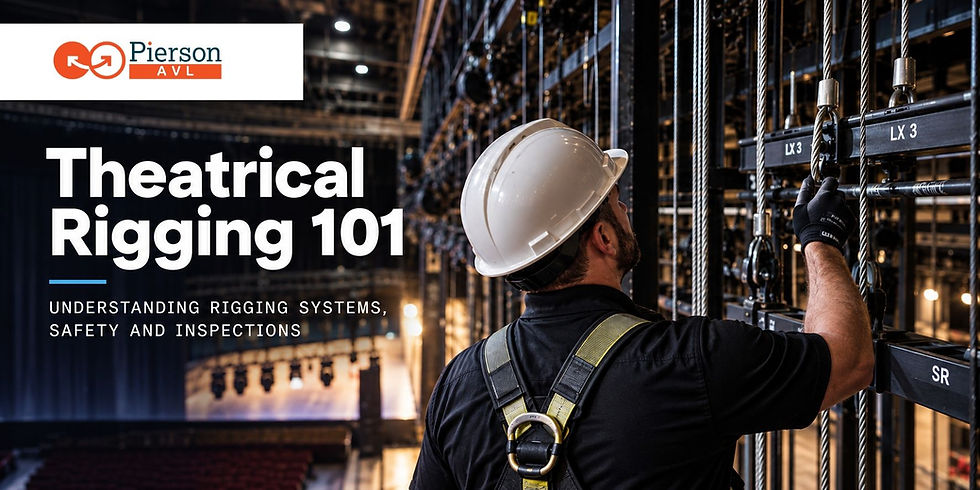
When you walk into a theatre, auditorium, arena or other performance space, your attention is naturally drawn to the stage. For good reason: that’s where the magic happens. But, as with a magic trick, much of what makes the experience possible happens outside your focus. Above the stage, an infrastructure of pipes, cables, tracks and machinery supports lighting, speakers, curtains, scenery and other production equipment. Much of it stays out of sight so the audience can focus on the performance.
That supporting infrastructure is commonly referred to as theatrical rigging. From simple static pipe grids to manual counterweight fly systems and sophisticated motorized equipment, rigging allows production teams to position equipment, change scenery and adapt a venue for different events. With loads suspended overhead, proper design, installation, operation, maintenance and inspection are essential to maintaining a safe performance environment.

When I was a young kid living in Washington State, I visited the Seattle Space Needle on a school field trip. I vividly remember another kid warning me that it was dangerous to stand beneath it because, “If someone dropped a penny from the top, it would kill anyone it landed on.” For a kid on a field trip, that was a memorable warning.
I later learned that the familiar falling-penny story greatly exaggerates the danger. A penny’s low mass and the air resistance it encounters as it tumbles limit its speed. That does not make dropping objects harmless, but the physics is more complicated than the story suggests. What stayed with me was the question it raised: what is above my head, and what keeps it there? That conversation sparked an interest that eventually led me to understand and appreciate rigging.
What Theatrical Rigging Supports
Theatrical rigging includes the systems and equipment used to suspend, support, raise, lower or position production equipment. Depending on the facility, it may carry theatrical lighting, stage curtains and drapery, scenery, backdrops, loudspeakers, projection screens and video equipment. Battens, pipes and truss may also be suspended as part of the system.
Some equipment remains permanently in position, while other systems move loads vertically above and onto the stage. There is no single rigging system that is right for every venue. The appropriate design depends on the building structure, stage configuration, intended use, equipment loads and operational needs.
Understanding the Different Types of Stage Rigging
Understanding the basic differences between rigging systems is useful when designing a new performance space, renovating a theatre or evaluating an aging installation.

Static or Dead Hung Rigging
Static rigging, sometimes called dead-hung rigging, supports equipment in a fixed position. A common example is a theatrical pipe grid above a stage, studio or performance space. Lighting fixtures, speakers and other approved loads can be attached at designated locations throughout the grid.
Because the system does not raise and lower equipment during normal operation, it can provide a straightforward solution for venues that do not need frequent repositioning or access at stage level. Safe access for adjustments and maintenance still needs to be considered.
“Static” should never be confused with “maintenance-free.” The equipment, attachment points and supporting components still need appropriate engineering, installation and regular inspection. A qualified person should establish the inspection scope and schedule for the installation, taking manufacturer instructions and operating conditions into account.

Manual Counterweight Rigging Systems
Manual counterweight fly systems have been a staple of theatrical spaces for generations. The weight of equipment or scenery attached to a batten, the horizontal pipe carrying the load, is balanced by counterweights held in a frame called an arbor. When properly balanced and operated, the system allows trained personnel to manually raise and lower substantial loads with controlled effort.
Components include battens, lift lines, blocks, arbors, counterweights, operating lines and rope locks. Adding or removing lighting fixtures, scenery or other equipment changes the balance of the line set. Proper loading procedures, balancing and operational training are therefore essential.

Motorized Rigging Systems
Motorized rigging uses powered hoists to raise, lower and position equipment. Some systems lift the entire load without counterweights; others combine powered machinery with counterweights. Motorized counterweight systems are one part of this broader category.
Depending on the design, motorized rigging can provide controlled movement, repeatable positioning and load sensing to help detect abnormal loading. It can also reduce manual handling. Counterweight-free systems eliminate manual balancing, while some counterweight-assisted designs handle load changes within their rated range without requiring operators to adjust counterweights.
Those benefits depend on the equipment and its configuration. A motor does not automatically increase the capacity of existing rigging, and load sensing does not establish that every batten, attachment or supporting component is appropriately loaded. The complete installation still needs to be designed for its intended use.
Motorized systems can be valuable where equipment needs to be repositioned regularly or where several trained users share a space. They also introduce mechanical, electrical and control considerations. Operators need training on the specific system, and automation does not remove the need for inspection, maintenance and safe operating procedures.
Curtain and Track Systems
Stage curtains may look simple compared with a fly system, but theatrical drapery can be surprisingly heavy. Main curtains, travelers, masking curtains, legs and borders require suitable supports and attachment hardware. Curtains that travel along tracks also depend on appropriately selected tracks, carriers and operating equipment.

A typical center-opening main curtain illustrates why the loading deserves attention. When the curtain is closed across the stage, its weight is distributed along much of the track. As it opens, the fabric gathers at the sides, concentrating each curtain panel’s weight over a shorter section of track. A one-way curtain creates a similar concentration at one end.
The total curtain weight has not increased; its distribution has changed. The track and its supports need to accommodate the curtain throughout its travel, including the positions where the fabric stacks. What looks like a simple opening curtain from the audience’s perspective involves more engineering than most people realize.
Speaker Rigging
Modern performance spaces often suspend substantial loudspeaker systems overhead. These installations require careful consideration of the manufacturer’s approved suspension methods, attachment hardware, supporting structure, load requirements and system configuration. Improvised mounts, unsuitable hardware or unapproved modifications can lead to failures with serious consequences.

Loudspeakers also introduce vibration into their mounting systems. Connections need to be installed and secured using the manufacturer’s specified hardware, tightening requirements and retention methods, with inspection for loosening or movement. Vibration is another reason that a connection that felt tight during installation still needs ongoing attention.
When equipment is hanging above people’s heads, “it seems secure” is not an adequate standard.
Why Theatre Rigging Safety Matters
Rigging failures are particularly serious because the equipment is overhead. A component that loosens, wears, deforms or fails can place people below it at risk. Many systems remain in service for decades, experiencing repeated use, changing loads, renovations, environmental conditions, modifications and normal wear.
The people operating those systems may change as well. Schools, churches, community theatres and multipurpose facilities often rely on a changing mix of employees, volunteers and students. Written procedures, training and clear responsibility for the equipment help keep important knowledge from disappearing when personnel change.
Rigging safety therefore needs ongoing attention throughout the system’s life. Good design and professional installation establish the foundation; trained operation, preventive maintenance and regular inspection help maintain it.
The Importance of Rigging Inspections
You would not want an airline to wait for a component to fail before inspecting the aircraft. The same principle applies to equipment supporting loads above people. A theatrical rigging inspection evaluates the system within an agreed scope and identifies conditions that may require maintenance, repair, further evaluation or replacement.
Industry guidance is available in ANSI E1.47-2020, Entertainment Technology — Recommended Guidelines for Entertainment Rigging System Inspections. Developed through ESTA’s Technical Standards Program and approved as an American National Standard, it addresses inspector qualifications, inspection scope and frequency, procedures and reporting.
Depending on the system, the inspection may cover wire rope and lift lines, battens, blocks and sheaves, counterweight arbors, operating lines, rope locks, hoists, machinery, connections and attachment hardware. Curtain tracks, suspended loudspeaker equipment and accessible structural attachment points may also be included. The exact scope and access limitations should be established before the work begins.
Manual and motorized rigging should generally receive professional inspection at least annually, with additional inspection following installation, alteration or repair before the affected equipment returns to service. The appropriate schedule and scope depend on manufacturer instructions, operating conditions and applicable requirements. Static rigging should also be included in the facility’s inspection program.
A useful inspection report documents what was examined, what was found and what action is recommended. It should help the owner distinguish conditions needing immediate attention from work that can be planned. Someone at the facility then needs responsibility for arranging corrective work and keeping records of its completion. Where the capacity of the building structure is uncertain, separate structural engineering evaluation may be needed.
Warning Signs Deserve Prompt Attention
Some concerns become noticeable between formal inspections. Unexpected noises, difficult or inconsistent operation, damaged or deteriorated lines, loose hardware, unusual movement and equipment that behaves differently all deserve attention. If damage or abnormal operation is observed, stop using the affected system, keep people clear of the potential hazard area and have a qualified rigging professional evaluate it before returning it to service.
Changes to the installation deserve attention as well. Adding, removing or relocating equipment can change both the total load and how it is distributed. The assumptions used to design or evaluate the original system may no longer apply. Have proposed changes reviewed before relying on existing supports for a new arrangement.
If no one at your facility knows when the rigging was last professionally evaluated, locating the records or arranging an inspection is a practical place to start.
Older Systems Deserve an Informed Evaluation
Age alone does not determine whether a rigging system is safe or unsafe. Condition, design, maintenance history, modifications and use all matter. Older systems may have years of wear or changes made by several generations of facility personnel, making a documented evaluation particularly useful.
An evaluation can help establish what is installed, its observable condition and the appropriate next steps. In some cases, maintenance or replacement of individual components may be sufficient. In others, modernization or a larger system upgrade may better meet the facility’s needs.
Rigging Safety Starts Before the Curtain Goes Up
Rigging deserves attention during design and installation, whenever equipment changes, and throughout routine operation and maintenance. An appropriate inspection program connects those activities by helping the owner track conditions and respond to developing problems.
Whether your facility uses a pipe grid, a traditional counterweight fly system, motorized rigging or several systems together, the equipment above the stage deserves the same attention as the equipment everyone can see below it. The audience should be able to focus on the magic. The people responsible for the space need to understand what makes it possible.
Talk with Pierson ProAVL about your Rigging
Whether you are planning a new performance space, modernizing an existing system or are unsure when your current rigging was last evaluated, Pierson’s ProAVL team can help. We work with schools, theatres, performing arts centers, houses of worship, corporate facilities and other venues on theatrical rigging design, installation, inspections, maintenance and upgrades.
From pipe grids and counterweight systems to motorized rigging, curtain tracks and suspended loudspeakers, we can help evaluate your space and determine the appropriate approach. Contact our team to discuss your system or schedule a rigging inspection.
Pierson ProAVL | designs@pierson.it | 717-323-6367


Comments